

Final Account Negotiations: Where Every Ghost of the Project Comes Back to Haunt You
aka: “The Project Is Done. The Fight Has Just Started.”

The handover certificate is signed. The snag list is (mostly) closed.
And then the final account process begins.
And out of the fog of completed works and faded memories comes every unresolved variation, every disputed backcharge, every withheld retention, every informal instruction that someone swore would “be sorted later,” and every claim that was parked during construction because there was a project to deliver.
Later has arrived. And it brought friends.
What a Final Account Is Supposed to Be
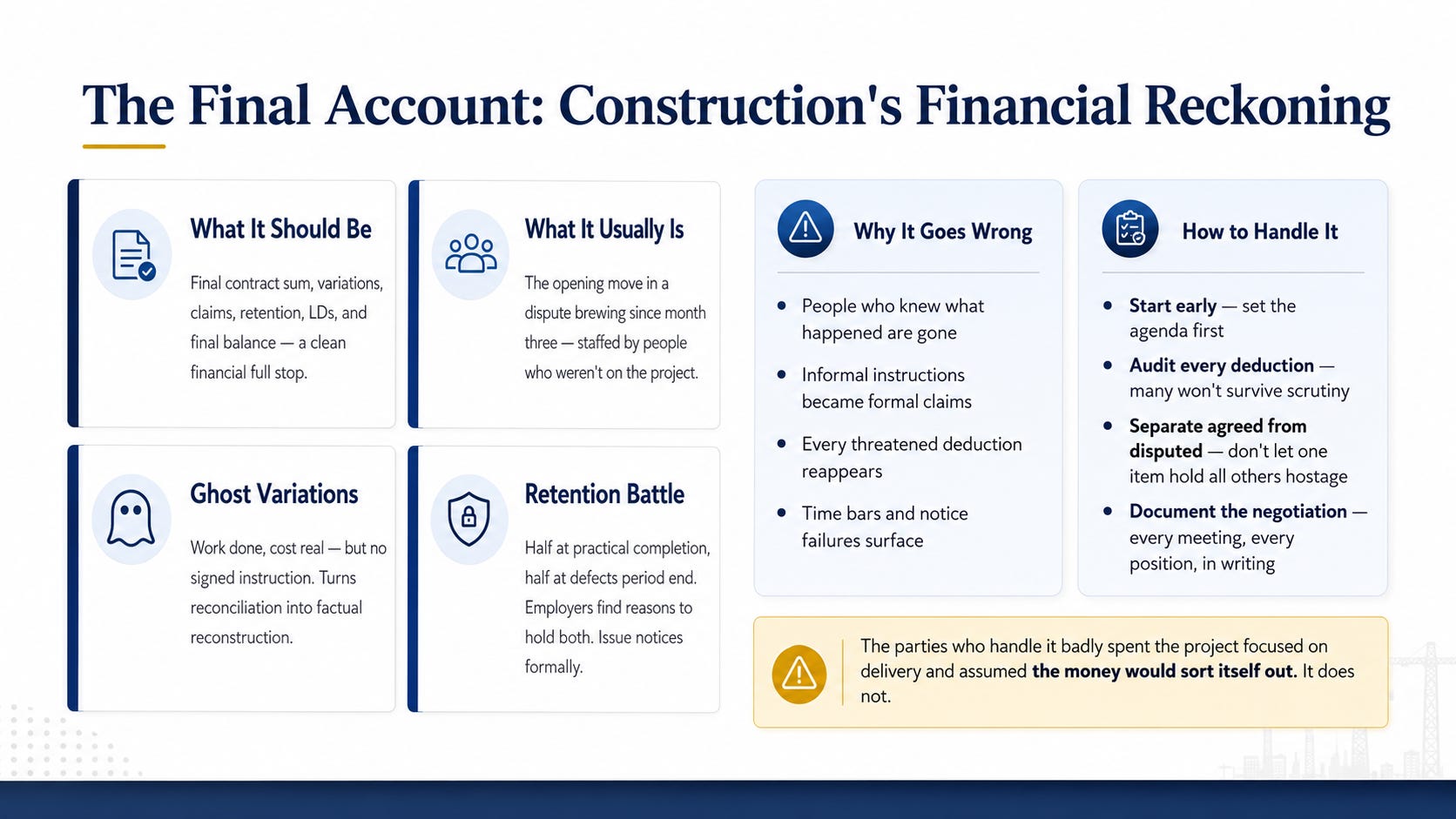
In theory, the final account is a clean, contractually structured settlement of everything financial between the parties at the end of a construction project. It captures:
the final contract sum, after all variations
all agreed additions and deductions
any outstanding claims by either party
retention adjustments
any liquidated damages applied
and the final balance - what is owed, by whom, by when
It is the financial full stop at the end of the project sentence.
In practice, it is rarely that clean. It is more often the opening move in a dispute that has been brewing since month three, staffed by people who were not on the project and armed with records that are incomplete, inconsistent, or missing entirely.
Why Final Accounts Go Wrong: The Real Reasons
The people who knew what happened are gone.
By the time the final account is negotiated, the project manager who gave the verbal instruction, the engineer who agreed the scope change, and the commercial manager who said “don’t worry about it” are all on other projects. Their replacements are reading files and drawing conclusions from documents that tell half the story.
The other half lived in conversations, site meetings, WhatsApp messages, and the institutional memory of people who are no longer in the room.
This is why contemporaneous records are everything. The email that felt like admin during construction becomes the only surviving evidence of what was actually agreed. If it was not written down, it is now a he-said-she-said in a final account meeting two years later.
Informal instructions became formal claims.
On every project, there is a category of work that happened without a proper variation order. The client asked. The contractor did. Everyone assumed it would be sorted out. It was not sorted out.
Now it is a final account item. And the client says there was no instruction. And the contractor says there absolutely was. And neither of them can find a contemporaneous document that resolves it cleanly.
This is not a legal problem. It is a contract administration problem that became a legal problem.
Every deduction that was threatened during construction reappears.
That backcharge for the scaffold the employer fixed when the contractor was slow - It is in there.
The liquidated damages that were mentioned in a letter in month eight but never formally applied - They are back.
The retention deduction for alleged defects that were never properly notified - Somehow, they made it into the draft final account.
Final account negotiations are where every threat, every grievance, and every deduction that was floated and never resolved comes back to life. Often without the evidence to support it. Sometimes without any contractual basis. But always with a number attached.
Time bars and notice failures surface here.
Contractors who did not issue notices in time - for variations, for delays, for disruption - find that their claims are challenged at the final account stage on procedural grounds, even if the substance is valid.
Employers who did not properly notify backcharges or deductions - in the manner required by the contract - find that their deductions are resisted on the same basis.
Everyone spent the project assuming the other side would not actually enforce the procedural requirements. The final account is where those assumptions are tested.
The Ghost Variations
There is a category of item in almost every final account that deserves its own heading: the variation that everyone knew about during the project but nobody properly processed.
These are dangerous because:
The work was done. It exists. You cannot un-pour the concrete.
The cost is real. It is in the contractor’s books.
But the variation order was never raised, or never signed, or was raised and disputed and then left in a drawer.
The contractor now claims it as an agreed change. The employer says it was within original scope. Both parties have a version of events that sounds plausible and neither has a signed instruction to resolve it.
Ghost variations eat final accounts alive. They turn what should be a financial reconciliation into a factual reconstruction of what happened on site, argued by people who were not there, from documents that were never designed to settle this question.
The only fix is variation control during construction: instructions issued promptly, scope agreed in writing, pricing settled before the work starts where possible, and any disputed items flagged formally at the time rather than stored for later.
The Retention Battle
Retention is a separate chapter of the final account fight, and it deserves direct attention.
Half the retention should have been released at practical completion. Sometimes it was. Often it was not - either because practical completion itself was disputed, or because the employer made deductions against it, or because the certificate was delayed while someone argued about the snag list.
The second half should be released at the end of the defects liability period, assuming defects have been properly notified and rectified. In practice, employers find reasons to hold it. The defects list stays open. The final certificate is delayed. The contractor is chasing money for work that was completed eighteen months ago.
Know your contractual entitlement. Know the trigger for release. Issue the necessary notices. Do not assume the employer will release retention without being asked, formally and in writing, at the right time.
If retention is being withheld beyond the contractual entitlement, that is a payment dispute, and it should be pursued as one - not absorbed into the general background noise of final account negotiations.
How to Approach the Final Account Properly
Start early.
Do not wait for the employer to issue a draft final account. By the time they do, the framing is theirs, the deductions are already listed, and you are playing defence.
Prepare your own final account position — every agreed variation, every claim you intend to pursue, every retention entitlement - and put it on the table first. The party that sets the agenda in final account negotiations has a structural advantage.
Audit the deductions.
Every deduction in the employer’s draft final account should be tested:
Was it properly notified under the contract?
Is it supported by a contemporaneous record?
Is there a contractual basis for the deduction — or is it a position?
Has it been quantified correctly?
Many deductions do not survive this scrutiny. They were threats made during construction that calcified into line items in a spreadsheet. Challenge them properly and early.
Separate the agreed from the disputed.
A common mistake is allowing the whole final account to remain open while parties argue about one contested item. Where items are agreed, get them agreed in writing and take them off the table. Do not let the employer hold agreed amounts hostage to disputed ones without good contractual reason.
Know your time limits.
Many contracts impose deadlines on final account submission and certification. FIDIC, for example, has specific timelines for the contractor’s statement and the engineer’s final payment certificate. Missing these deadlines may not automatically destroy your position, but it creates complications and gives the other side arguments you do not need.
Document the negotiation.
Every meeting, every position taken, every concession offered - put it in writing immediately afterwards. The final account negotiation is itself a record that may matter later. If it ends in agreement, have a formal settlement document. If it ends in dispute, the record of what was offered and rejected will matter.
When the Final Account Becomes an Arbitration
Sometimes it does. Not because the parties were unreasonable, but because the gap is too large, the underlying facts are too disputed, and neither party is willing to accept a number that looks commercially irrational.
When that happens, the quality of the project records - the variation instructions, the payment certificates, the site diaries, the correspondence about disputed items -becomes the determinative factor.
The contractor who documented the project as it happened will always be in a stronger position than the one who documented it retrospectively. The employer who notified deductions properly and on time will always defend better than one who invented them at the final account stage.
The final account is not where the dispute is won or lost. It is where the consequences of how the project was managed become financially visible.
The final account is the project’s financial reckoning. Everything that was left unresolved, every instruction that was given informally, every claim that was parked, every deduction that was threatened - it all shows up here, with interest.
The parties who handle it well are the ones who managed the project commercially from the start.
The parties who handle it badly are the ones who spent the project focused on delivery and assumed the money would sort itself out at the end.
It does not sort itself out.
It waits. Quietly. And then it sends a draft final account with a number that makes your eyes water.